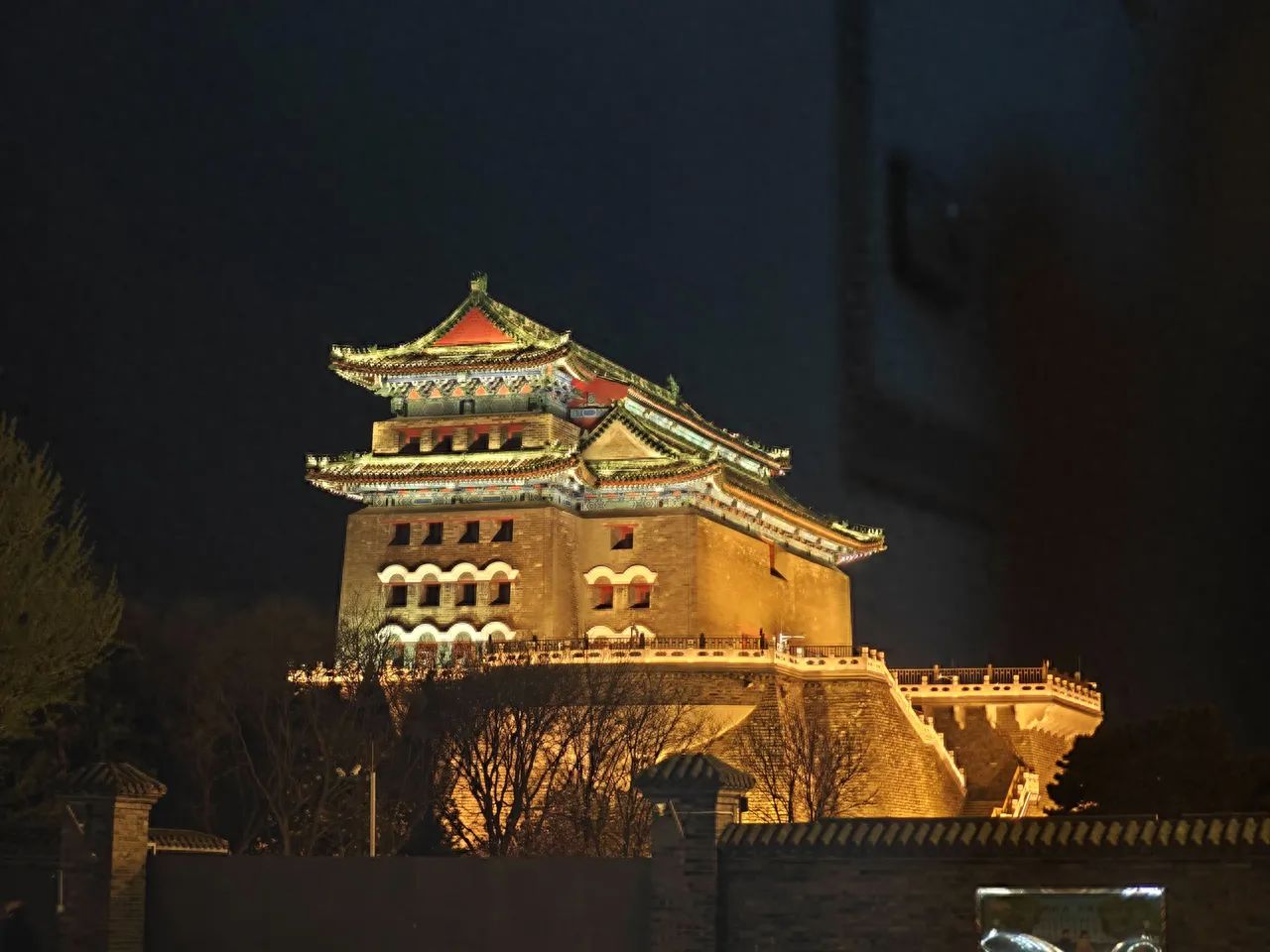
The photographer stood to the side of the arrow tower and used a low-angle shot to capture the entire structure. A medium-telephoto lens was used with a central composition to place the main subject, the arrow tower, at the center of the frame, highlighting the subject.

Travel Tips: The arrow tower is open from Tuesday to Sunday, 9:00 AM to 5:00 PM (last entry at 4:30 PM). It is closed on Mondays except for public holidays.

Zhengyangmen Arrow Tower - Capture the night view of the side of the Arrow Tower.
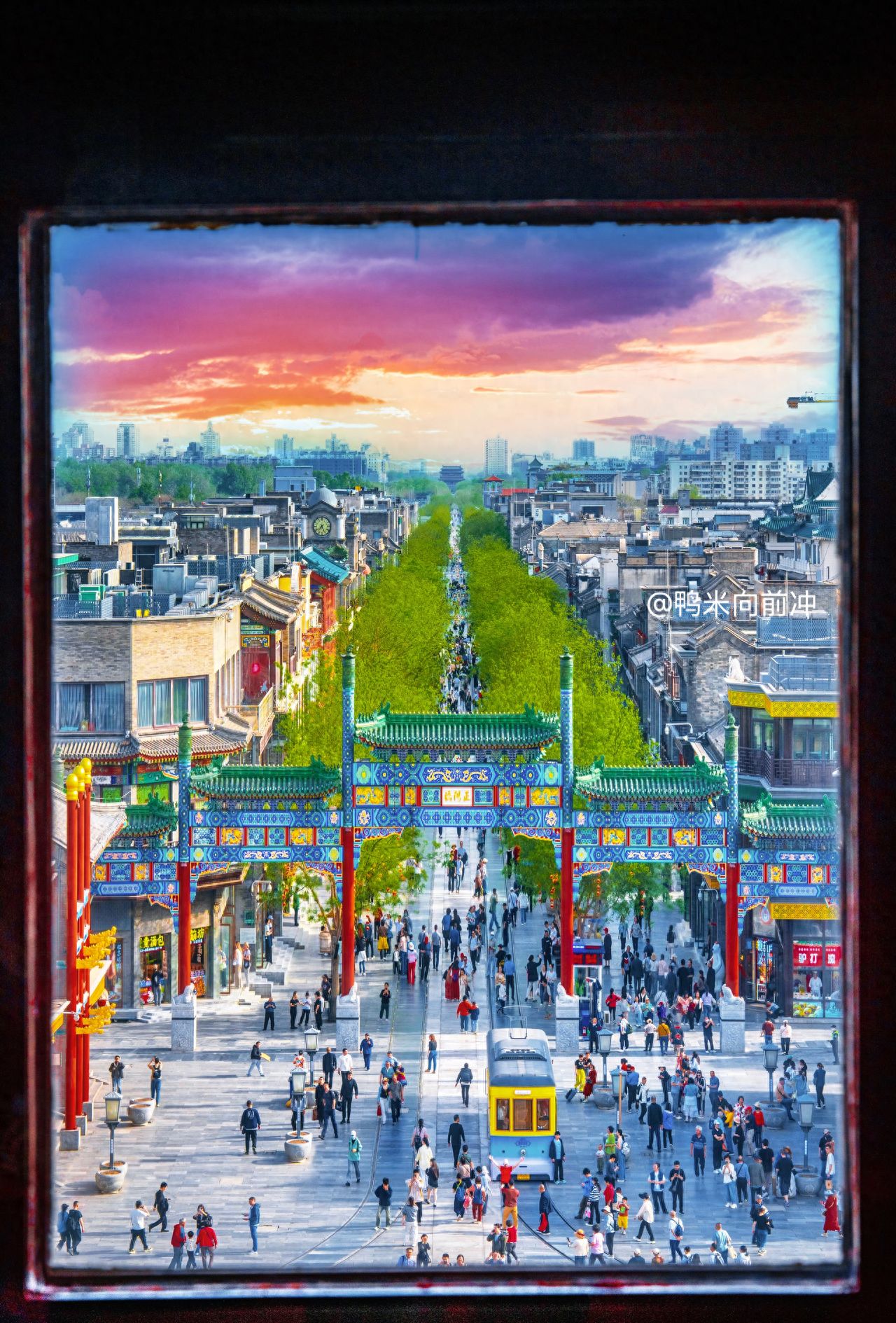
The photographer uses frame-within-a-frame composition, employing the window frame to create a visual boundary that enhances the depth and focus of the image. The main subjects are the Zhengyang Gate archway and the street, with the background capturing the distant buildings and sky, adding depth and visual guidance. It is recommended to use a telephoto lens, which is suitable for compressing the distance and making the street appear longer.

Travel Tips:
1. Reserve your visit at least 7 days in advance through the official WeChat account of the Beijing Central Axis Heritage Conservation Center. Tickets are released at 17:00 daily, and the site is closed on Mondays.
2. Opening hours are from Tuesday to Sunday, 9:00-17:00 (last entry at 16:30). Guided tours are available at 9:30, 11:30, 13:30, and 15:30 in the first-floor lobby, lasting about one hour.

Zhengyangmen Arrow Tower - Aerial view of the door frame of Zhengyangmen.

Photo by Zhongshan Park in Beijing - Ancient Architectural Eaves and Golden Ginkgo

Zhongshan Park in Beijing - Ancient Architectural Eaves and Golden Ginkgo

From the vantage point, the photographer stands at a slight angle in front of the corner tower, capturing the scene at eye level, showcasing the complete view of the tower and the water. The composition uses symmetrical framing, with the water serving as the axis of symmetry, mirroring the tower and its reflection to create a sense of balance and stability. A medium to long focal length lens is used to compress the space, emphasizing the architectural details of the tower and highlighting its ancient and solemn beauty.

Travel Tip: Admission is free.

The Forbidden City - capture the northwest corner tower and the lake surface.

Photo by Zhongshan Park in Beijing - Square capturing the side of red wall architecture.

Zhongshan Park in Beijing - Square capturing the side of red wall architecture.

Use symmetrical composition to highlight the solemnity of the Meridian Gate; frame your shot through doorways or window lattices to add depth and interest to the image; you can also try shooting from a low angle to emphasize the grandeur of the Meridian Gate.

1. Equipment Settings: It is recommended to use a full-frame DSLR or mirrorless camera with a super wide-angle lens (14 - 24mm) to capture the entire majestic view of the Meridian Gate and the surrounding night scenery, or a telephoto lens (70 - 200mm) for detailed close-ups of the gate.
2. Shooting Time: The best time for photography is from 7 PM to 9 PM on Fridays and Saturdays, when all the lights of the Meridian Gate are on, and there are relatively fewer tourists, allowing for better composition without crowd interference.

The Forbidden City - Meridian Gate railing area

Photo by Zhongshan Park in Beijing - Ancient Architectural Archway

Zhongshan Park in Beijing - Ancient Architectural Archway

Photo by Temple of Heaven - Taking a photo with the Hall of Prayer for Good Harvests

Temple of Heaven - Taking a photo with the Hall of Prayer for Good Harvests

The photographer stands at a relatively rear position inside the Qianqing Palace and uses an upward shooting angle. This position and angle allow the 'Zhengda Guangming' plaque, dragon motifs, and the throne to be fully captured in the frame, emphasizing the solemnity and grandeur of the interior architecture of the Qianqing Palace and showcasing the majesty of the imperial palace. The composition employs a central framing technique, placing the 'Zhengda Guangming' plaque and the throne at the center of the frame, making them the focal point. Additionally, the inherent symmetry of the architecture, with elements distributed evenly on both sides, enhances the stability and order of the image, highlighting the neat layout and traditional Chinese aesthetics of the Qianqing Palace.

1. Travel Tips: For the morning session ticket to the Forbidden City, the latest check-in time is 12:00 PM. For the afternoon session ticket, the earliest check-in time is 11:00 AM. It is recommended to arrive early when there are fewer people, which will improve the visual effect of the photos.

2. Additional Tips:
① Wear comfortable shoes, as there is a lot of walking in the Forbidden City.
② There are no power banks available for rent inside the Forbidden City, so it is advisable to bring your own.
③ Reflectors for photography are not allowed inside the Forbidden City, and tripods over 1.3 meters in height are also prohibited.

The Palace Museum - The plaque in the hall reads "Glorious and Bright".
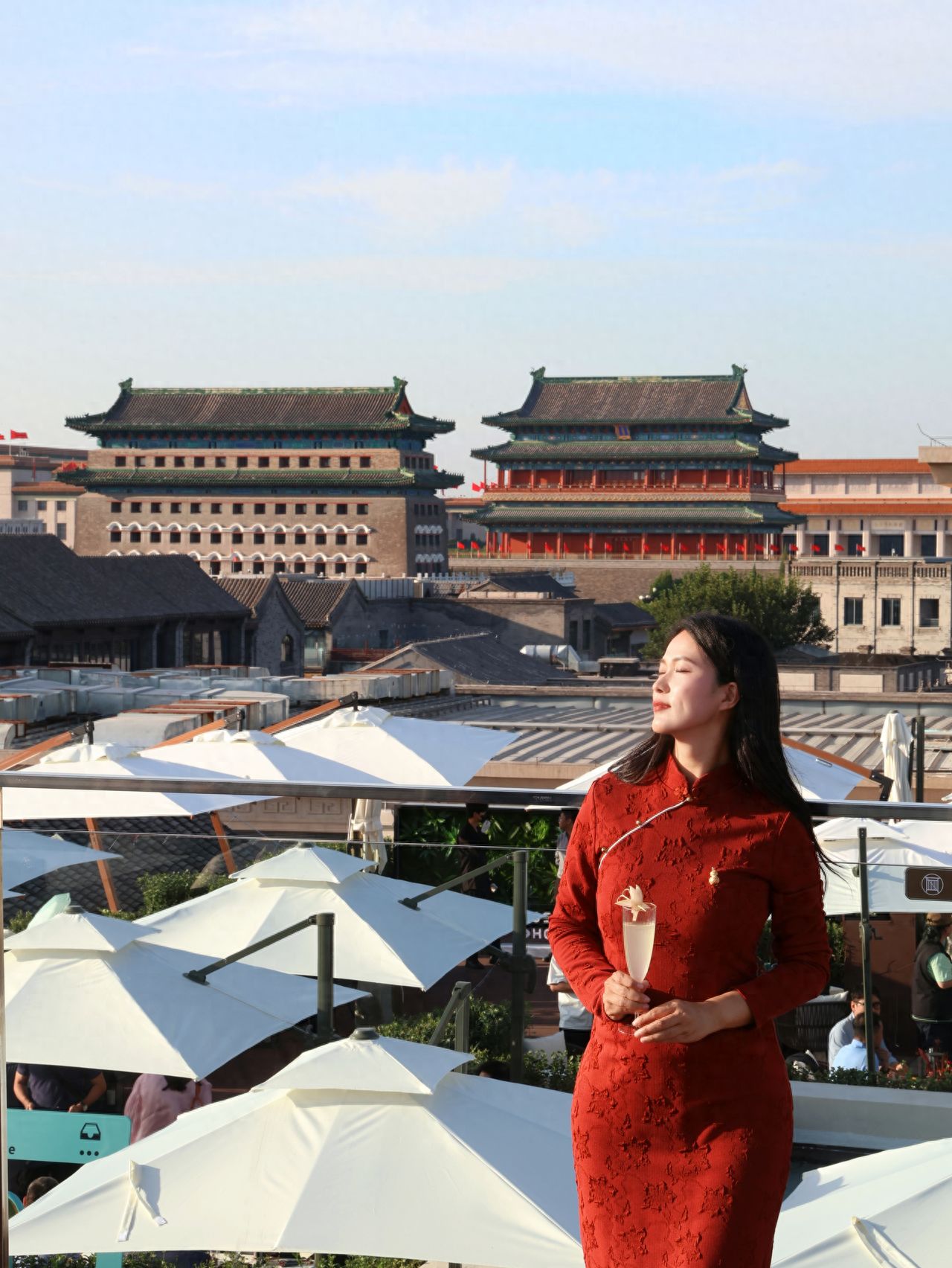
The model stands at the edge of the terrace, while the photographer, positioned opposite the model, uses a level shot technique. The model is placed at the right one-third of the frame according to the rule of thirds, aligned with the central axis, with the background incorporating the ancient architectural complex along the central axis.

Travel Tip: The best time for shooting is at sunset when the light is optimal.

Beijing Tiananmen Huajian Tang - Terrace and Ancient Architectural Complex